The platform
Eight levels of lending technology. We operate at six to eight.
Most lenders digitised the old model — apps, copilots and paperless workflows layered on top of branches and relationship managers. Levels six to eight replace it: an army of AI agents runs every function, improves daily, and a human signs the credit.
One loan, five stages
From a shop nobody had lent to, to a signed memo and a calendar that fits how it earns

The shop is found before it applies
Odin reads street imagery PIN code by PIN code — every name board, the size of the frontage, the category, the footfall it implies — and scores lend probability for each business. A tailor in Villivakkam who has never borrowed from a bank is on the map with a pre-qualified range before anyone from the lender leaves a desk.
- 1,50,000+ site videos in the visual model
- 816 PIN codes with at least one live loan
- The lender sees the enumerated pipeline for its own geography
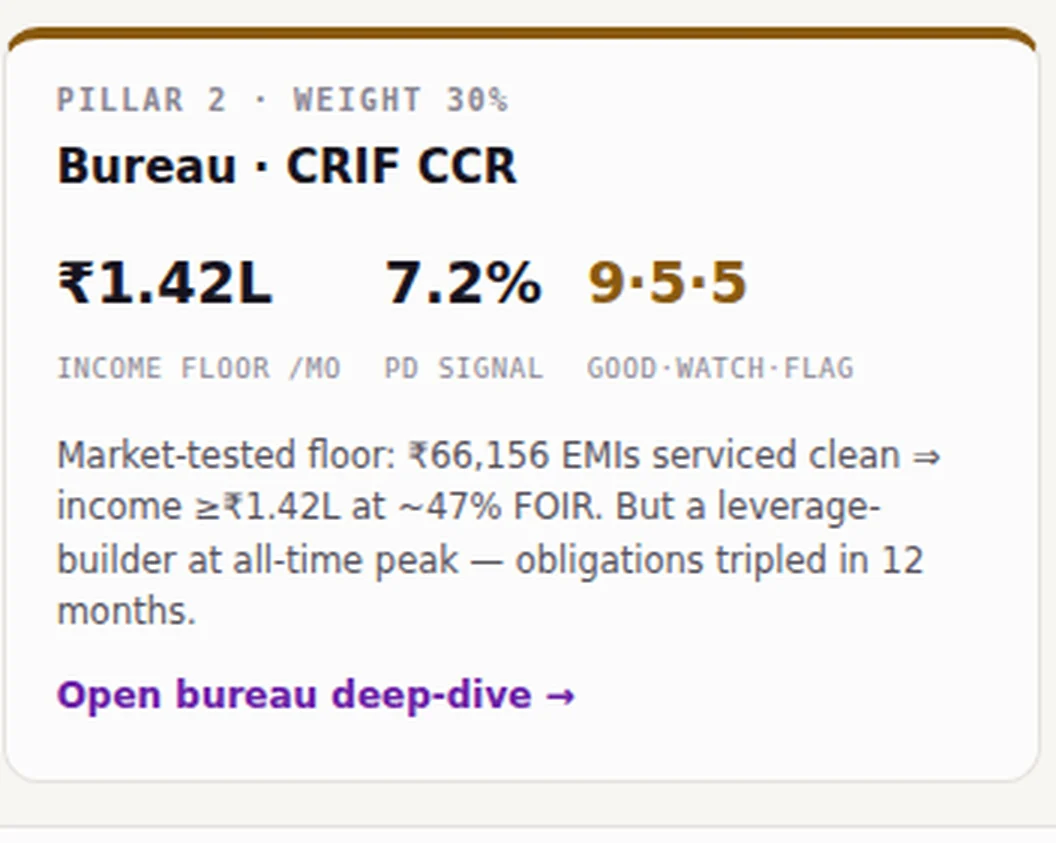 J1 · Bureau · ≈60 s
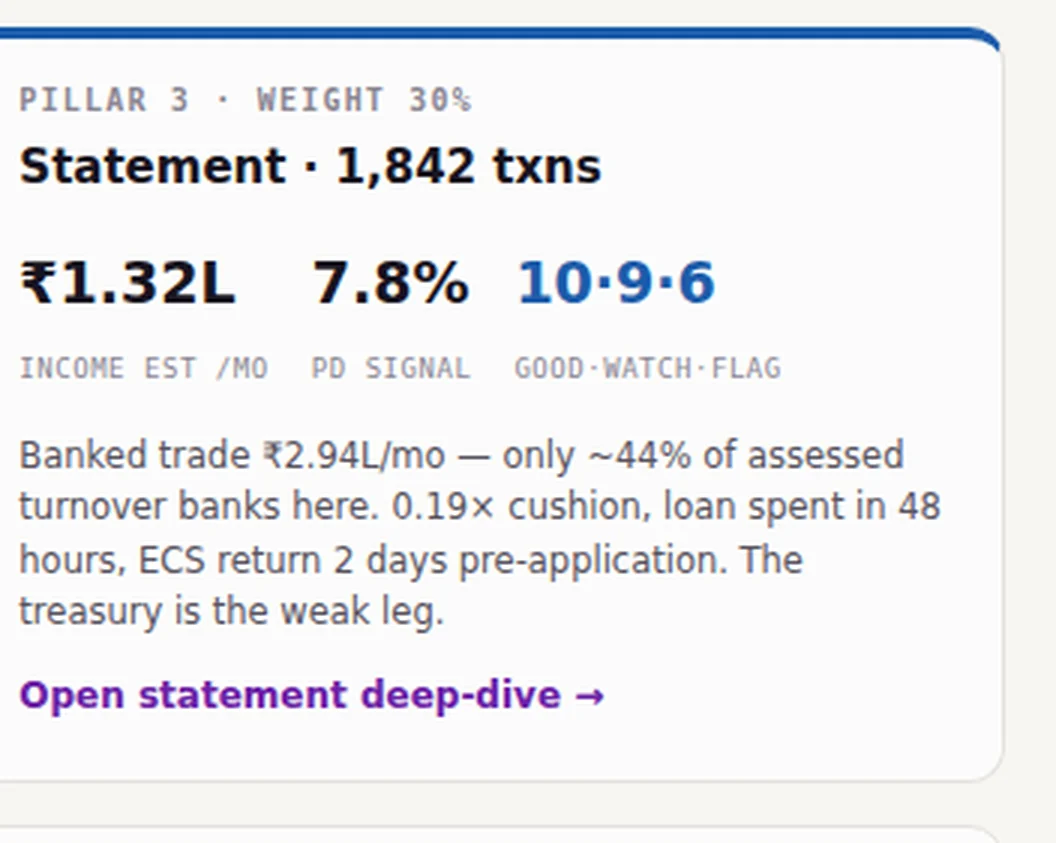 J2 · Bank statement · minutes
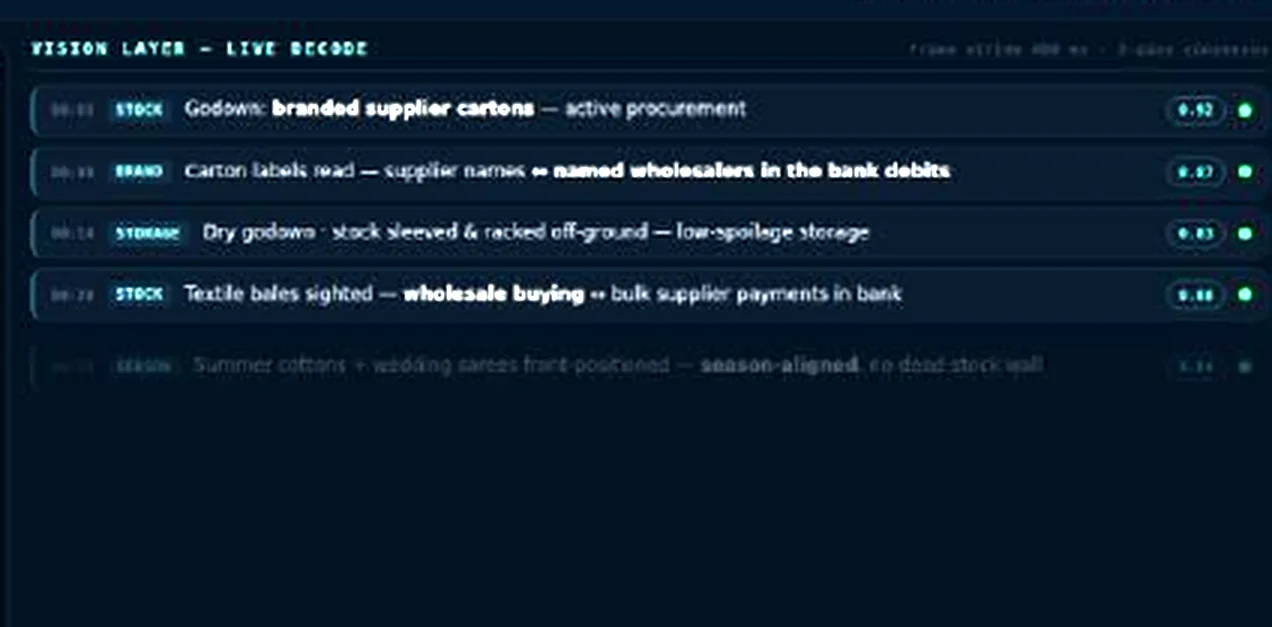 J3 · Shop on video · field visit
 J4 · Voice PD · AI call
Evidence is gathered gate by gate, and the next rupee is spent only if the last gate passed
Janus spends underwriting effort progressively. Two bureaus first; then Account Aggregator bank statements; then the shop itself, on video, filmed by a dispatched field officer; then a structured voice interview. Socrates — the ML engine trained on every applicant and repayment since 2022 — scores each stage against what actually got repaid.
- 4,000+ parameters scored per application
- Bank data through licensed Account Aggregators under DPDP consent
- One field visit, filmed — the officer never re-keys a document
The memo shows its reasons. A credit officer decides.
The memo reaches a head-office credit officer in under nine minutes with the recommendation, every contributing parameter, the exceptions against policy and the draft offer. The officer approves, modifies or declines. On partner rails the partner’s board-approved credit policy binds the recommendation and the partner’s officer signs.
- 100% of credit decisions carry a human signature
- Every automated recommendation is logged and auditable
- Champion–challenger and drift monitoring on the models behind it

The calendar is built around the shop’s trading week, not the bank’s month
The collection cadence is read from the bank statement’s cash-flow signature. A three-layer stress budget sizes the instalment; weekly miss probability is computed for this borrower; the 133-day calendar places collection days, weekly rests, festival closures and ten strategic holidays where the stress model says the shop will need them.
- Daily, weekly or monthly instalments matched to how the shop earns
- iLCS fires the auto-debit at the hour of peak balance
- 92.7% of scheduled instalments collected digitally on the due date

Monitoring starts on day three, not day thirty
Continuous learning on repayment conduct — debit returns, inflow against baseline, the shop’s own seasonality — raises early-warning signals long before a loan is delinquent by any regulatory definition. The response is digital first and human last: re-timed debits, a voice call, a calendar adjustment, and only then a dispatched officer.
- 96% of missed instalments resolved with no field visit
- Every signal, action and outcome feeds the next origination cycle
- The lender sees the same board in its own portfolio view
The agents
Four twins of the jobs that made this segment unbankable
Origination engine
Agent Odin™
Odin walks the street in imagery — reading every name board, sizing every shop, scoring lend probability — so a pre-qualified offer exists before anyone leaves a desk. Other lenders angle for one customer at a time; Odin enumerates the whole pond.
Maps and scores every urban micro-business, PIN code by PIN code.

Credit intelligence
Agent Janus™
Janus reads bureau data, account-aggregator bank statements, the shop itself through a camera, and the borrower through an AI voice call — assembling a credit memo that reaches a human officer in under nine minutes.
Underwrites 4,000+ signals through four progressive gates.

Field management
Nemesis AI™
Algorithmic task allocation and route optimisation turn a field officer from a territory owner into a dispatched resource — so one officer looks after six hundred loans rather than one hundred and fifty.
Routes and tracks the field force the way a ride-hailing app runs a fleet.

Portfolio & collections
Saras AI™
Continuous machine learning on repayment conduct triggers early-warning signals at three days past due, not thirty — and settles collections digitally on daily instalments matched to the merchant’s cash flow.
Watches repayment health daily and nudges before stress becomes default.
The autonomous lifecycle
Hyper-local sourcing to instant disbursement, with a human at the one point that matters
A green rule marks the steps an agent runs on its own. Step 04 has none by design: disbursement is an act of the regulated balance sheet, not of the software.
Underwriting
Four gates, one memo, a human signature
Janus spends the next rupee of underwriting effort only on applicants the previous gate qualified. Socrates — the machine-learning engine trained on every FriendLoan applicant, loan and repayment since 2022 — scores each stage against what actually got repaid.
The customer consents in the app; two bureaus are pulled; hard rules plus the Socrates score decide whether more underwriting effort is worth spending.
Account Aggregator statements: UPI income set against every bureau obligation. One shop photo gives a first read of daily revenue.
The field officer films; Janus decodes the shop live — stock, footfall, premises — every frame geotagged, agent-stamped and time-stamped.
A 28-question personal discussion. Deviations across shop, bureau and bank are clarified and scored.
The credit memo, the draft offer and a video personal discussion go to a head-office credit officer, who approves, modifies or declines — then the repayment calendar is built around the borrower’s own trading week.

Every automated recommendation is logged and auditable. On partner rails the partner’s board-approved credit policy binds the decision.
Product design
Repayment shaped to the borrower’s cash flow, not a calendar
A shop earns every day. A monthly EMI landing at the wrong moment creates artificial default. FriendLoan collects in daily or weekly micro-instalments calibrated to each merchant’s liquidity cycle — and iLCS fires the auto-debit at the hour the balance is highest.
Traditional NBFC
- One large monthly debit at peak liquidity drag
- Standard NACH drives 30%+ bounce rates
- Binary schedules fail in festival seasons and cash squeezes
- Cash still collected at the doorstep
FriendLoan engine
- Daily / weekly micro-instalments matched to real cash flow
- Auto-debit timed to the hour of peak balance
- Dynamic amortisation with holiday toggles from 52-week cash-flow modelling
- 100% digital capture — zero cash, zero doorstep risk
One loan, engineered end to end. The schedule is not a calendar with holidays bolted on — the holidays are the schedule. Socrates forecasts a weekly probability of missing, stacks the borrower’s own cash-flow dips on top of trade seasonality and population-wide events, and spends a fixed stress budget on rest days placed exactly where the curve peaks. Ten pre-planned holidays absorb about 65% of built-up stress and cut expected missed payments by roughly 68% over the term. A miss that was planned is a rest day; a miss that was not is a default. Illustrative worked example.
See Odin walk a street.
A live walkthrough of the origination engine, on request, in a first meeting with our partnerships team.
Lending partners
Institutional lending partners
 AU Small Finance Bank
 Anupam Finserv
 Baid Finserv
 BlackSoil Capital
 IBL Finance
 InCred Financial Services
 Kaleidofin Capital
 Kiyansh Finance
 MAS Financial Services
 RAR Fincare
 Real Touch Finance
 SMC Finance
 Shriram Finance
 Singularity Creditworld
 UC Inclusive Credit
 Universal Fingrowth
 Usha Financial Services
 Varanium Capital
 Vivriti Capital
 Western Capital Advisors